

Two homes can sit ten minutes apart in the Houston area. One gets water from the city. The other gets water from a MUD. The water in those two homes can differ a lot. And that difference shows up in your pipes, your water heater, and your monthly bill.
This guide explains the City of Houston water vs. MUD water question in plain words. You will learn where each type of water comes from, what it does to plumbing, and what you can do about it.
Quick Answer
City of Houston water is mostly treated lake and river water. It is usually softer. It is cleaned with chloramine.
MUD water is often well water pumped from deep underground. It is usually harder. It often has more iron and minerals. Many MUDs use free chlorine instead.
Harder water means more scale. More scale means your pipes and appliances last less. That is the short version.
Part 1: Who Actually Sends You Water?
The City of Houston system
The City of Houston runs one of Texas’s largest water systems. Houston Public Works manages it. The Houston Public Works drinking water system is called Houston Water, and its public water system ID (PWS ID) is TX1010013.
If you live inside city limits, the city is your retail water provider. You get one bill from the city.
The MUD system
A MUD is a Municipal Utility District. It is a small government body created by the state. A municipal utility district water supply serves one specific neighborhood, not a whole city.
Texas started creating MUDs in the late 1960s. They took off in the Houston area in the 1980s, when growth outpaced the City of Houston’s ability to expand. Today, Texas has more than 950 MUDs, plus around 400 other water districts. Most of them sit in the ring outside a city called the extraterritorial jurisdiction, or ETJ.
That is why extraterritorial jurisdiction (ETJ) water service matters. Your mailing address may say Houston. Your water may still come from a district. Unincorporated Harris County water service almost always comes from a district, not the city.
How to find your provider
People often ask, who is my water provider by address? Here is how to check:
- Look at the name printed on your water bill. Do not guess by ZIP code.
- Use the TCEQ Water Districts Map Viewer to see if a district covers your lot.
- Check your tax statement on the Harris County Appraisal District (HCAD) site. A MUD line item is a strong clue.
- Look up special district records with the Texas Comptroller of Public Accounts.
Who runs a MUD day to day?
A MUD does not have city staff. It hires a MUD district operator company. Common operators in the region include Inframark, Si Environmental, and Municipal District Services (MDS).
An elected board makes the choices. You can attend a MUD board of directors meeting and speak. Districts such as Spring Creek Utility District, Windfern Forest Utility District, and numbered ones like Harris County MUD Nos. 18, 191, 208, and 501 all post meeting dates online.
The Texas Commission on Environmental Quality (TCEQ) oversees water districts. Some rate and service matters fall under the Public Utility Commission of Texas. The Association of Water Board Directors of Texas (AWBD) trains district board members.
Part 2: Where the Water Comes From
This is the heart of the surface water vs. groundwater Houston story.
City water is mostly surface water
A treated surface water supply starts in a lake or river. Houston draws from Lake Houston, Lake Conroe, Lake Livingston, the San Jacinto River, and the Trinity River. The San Jacinto River Authority and the Gulf Coast Water Authority help move raw water around the region.
Big plants clean that water. These include the Northeast Water Purification Plant, the East Water Purification Plant, and the Southeast Water Purification Plant. The Luce Bayou Interbasin Transfer Project moves Trinity River water into Lake Houston to keep supply steady.
Lake water carries dirt and algae. Plants must control turbidity in surface water before the water is safe.
MUD water is often groundwater
A groundwater well supply pulls water from deep rock layers. About 13 to 15 percent of the city’s own supply, and close to 100 percent of the supply for many suburban MUDs in areas like Cypress, Katy, and The Woodlands, comes from the Gulf Coast Aquifer system. That system has three main layers: the Chicot Aquifer near the surface, the Evangeline Aquifer deeper down, and the Jasper Aquifer deepest of all. This groundwater has little of the cloudiness found in lakes, but it is full of dissolved solids, plus iron, manganese, arsenic, and natural radioactive material.
That is the key point. Well, the water is clear. It is also loaded with minerals.
Part 3: Hard Water 101
What hardness means
Hard water holds calcium and magnesium ions. When water dries, those minerals leave a white crust. That crust is mostly calcium carbonate (CaCO₃). Plumbers call this calcium carbonate hardness.
Magnesium adds to the total.
How hardness is measured
Two units are used:
- Water hardness in grains per gallon (gpg) is used to size treatment gear.
- City reports use hardness in ppm, or mg per liter.
To convert, divide ppm by about 17.1.
The Water Quality Association rates water as soft below 3.5 gpg, moderate from 3.5 to 7.0 gpg, hard from 7.0 to 10.5 gpg, and very hard above 10.5 gpg.
Houston is not one number
Here is the part most articles get wrong. In 2025, Houston’s hardness ranged from 43.5 to 229 ppm. That is 2.5 to 13.4 grains per gallon, with an average near 7.9 gpg. Surface water areas are softer. Groundwater areas are harder. So your hardness depends on which plant serves your address, not on Houston as a whole.
Houston Public Works reported an average total hardness of about 137 mg/L, or 8.0 grains per gallon, in its 2023 report.
So moderately hard water and very hard water classification can both be true inside one city. That is why hardness by neighborhood or ZIP code matters more than a citywide number. A Houston water hardness map is a starting point, not an answer.
Katy, Cypress, and Spring water hardness often runs above the city average. The same is true for Fort Bend County MUD well water.
Test your own water
Buy a water hardness test kit for a few dollars. Or ask your provider. It takes five minutes and cuts down on guesswork.
Total dissolved solids (TDS) is a second useful number. It counts everything dissolved in the water, not just hardness.
Part 4: Other Things in the Water
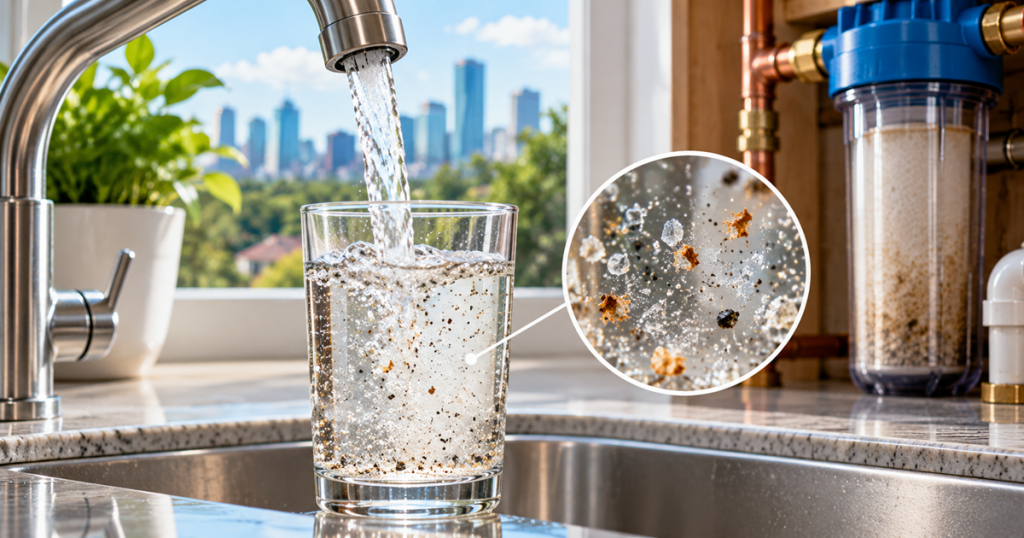
Well water carries more than hardness. Watch for these:
| What it is | What you notice |
| Iron in well water | Orange stains in sinks and tubs |
| Manganese staining | Black or gray specks and streaks |
| Hydrogen sulfide (H₂S) | A rotten egg smell |
| Sulfate in groundwater | Bitter taste, loose stomach |
| Sodium and chloride content | Salty taste, faster metal wear |
| Radium and uranium in groundwater | No taste, tested and reported by law |
| Arsenic in Gulf Coast aquifer wells | No taste, tested and reported by law |
The rotten egg odor comes from hydrogen sulfide gas. It forms when sulfur bacteria break down organic matter in the water or in the plumbing itself.
Will the water eat your pipes?
Three numbers tell you:
- Tap water pH level. Low pH is more corrosive.
- Alkalinity and buffering capacity. This keeps pH steady.
- The Langelier Saturation Index (LSI). This predicts if water will leave scale or strip metal.
High LSI means scale-forming water. Low LSI means high water corrosivity. Most Houston-area water leans toward scale. Some converted systems swing back and forth during the change.
Part 5: Chlorine vs Chloramine
This is the biggest hidden difference between city and MUD water. And it hits plumbing directly.
The two disinfectants
Free chlorine works fast but fades fast. Monochloramine is chlorine mixed with ammonia. It lasts longer in long pipe runs.
Here is a real example of the chloramine vs chlorine disinfection switch. One Harris County MUD told residents its groundwater was treated with chlorine, but it would switch to monochloramine for surface water because chloramine lasts longer in the system and creates fewer regulated disinfection byproducts.
So when your MUD converts, it replaces your free chlorine residual with a monochloramine residual. Your water smells different. And your rubber parts start to age faster.
Why byproducts matter
When chlorine meets natural material in lake water, it forms disinfection byproducts (DBPs). The two regulated groups are total trihalomethanes (TTHM) and haloacetic acids (HAA5). Chloramine makes fewer of them. That is the main reason big systems use it.
The seasonal switch
Many districts run a free chlorine burnout period once a year. This is also called a temporary chlorine conversion or chlorine maintenance.
One Harris County MUD paired its temporary switch in disinfectants with extra hydrant flushing. The district described this as a standard step in warmer months, when organic growth can affect odor and taste, and posted signs at neighborhood entrances.
Expect a stronger pool smell for a few weeks. That is normal. It is also a good time to change filters.
A seasonal disinfectant switch notice should arrive by mail, email, or text.
Nitrification
Chloramine systems can suffer nitrification in distribution lines. Ammonia feeds bacteria. The disinfectant level drops. Water quality slips. Flushing and the yearly chlorine burnout are the usual fixes.
What chloramine does to your plumbing
This is the part homeowners miss:
- Rubber gaskets and O-rings degrade faster. Chloramine damage to rubber seals is a known cause of slow drips.
- Older homes may see lead solder corrosion in pre-1986 homes. Research on lead solder found that free chlorine can form a protective Pb(IV) scale, while chloramine does not form that scale in the same way, which helps explain lead spikes at some utilities that switched from chlorine to chloramine. This work came out of Virginia Tech, where Marc Edwards and colleagues study premise plumbing.
- The Reduction of Lead in Drinking Water Act means new parts are lead-free. Old parts are not.
- Low disinfectant levels in warm pipes can let Legionella pneumophila grow. Conditions inside home and building plumbing can drive disinfectant levels down and encourage these organisms to grow. The Centers for Disease Control and Prevention publishes guidance on managing that risk.
Two more chloramine notes. Aquarium water and chloramine toxicity is real, so use a conditioner made for chloramine. And pool and spa water chemistry changes when fill water changes, so retest after a conversion.
Part 6: Water Pressure, City vs MUD
Pressure is a second major difference. And it is written into code.
The legal limits
Houston’s residential code says static water pressure must not exceed 80 psi. Where the main pressure goes above 80 psi, an approved pressure-reducing valve meeting ASSE 1003 or CSA B356 must be installed on the domestic water branch main or riser.
So a pressure-reducing valve (PRV) is not optional above that level. The 80 psi static water pressure limit protects your fixtures. Brands like Watts and Zurn make common valves.
On the supply side, engineers usually design Texas systems to maintain at least 35 psi at all service connections during normal use and at least 20 psi during fire flows, under TCEQ rule 290.44. TCEQ also typically requires about 200 gallons of total storage per connection for community systems.
That is where the minimum 35 psi at the service connection target, the peak-hour demand and fire flow rules, and the 200 gallons of storage per connection standard come from. These sit in 30 TAC Chapter 290 and TCEQ §290.44.
How MUDs make pressure
City systems use large mains and big pumps. MUDs are smaller. They often use:
- A hydropneumatic pressure tank that holds water and air under pressure.
- Ground storage vs. elevated storage tank choices based on land and cost. Steel tanks follow ANSI/AWWA D100. Pressure vessels carry an ASME Boiler and Pressure Vessel Code stamp.
- A pressure booster pump system, often built with Grundfos or similar pumps.
What this means inside a tall house
Pressure drops as water climbs. Homeowners can expect 16 to 18 psi at the top of the second floor and 6 to 8 psi at the top of the third floor. Builders in that neighborhood must install residential pressure booster pump systems in all four-story homes, and many three-story homes get one too, even though code does not require it.
So three-story and four-story home water pressure is a planning issue, not a complaint issue. Budget for a booster if you are building tall.
Test it yourself
Buy a hose bib water pressure test gauge. Screw it onto an outside faucet. Read it with no water running.
- Under 40 psi: weak. Look for low water pressure from mineral deposits or a partly closed valve.
- Over 80 psi: risky. High water pressure can slowly and silently damage pipes.
High pressure also causes water hammer and pipe noise that bangs when a valve shuts off.
Expansion tanks
Once you add a PRV or a backflow device, your home becomes a closed system. Hot water has nowhere to expand. That is why a thermal expansion tank requirement exists. An expansion tank on a closed system protects your water heater and joints.
Why pressure wobbles
You may notice water main pressure fluctuations during peak morning use. You may also notice pressure fluctuations after hydrant flushing. Both are normal and short.
Part 7: Flushing, Notices, and Odd Water Days
MUD customers get more notices than city customers. That is a feature, not a flaw. Small systems tell you more.
- Unidirectional hydrant flushing program: crews push water one way through mains to scrub them clean.
- Discolored water after flushing: brown or yellow water for a few hours. Run a cold tap until clear. Do not wash whites.
- Dead-end water main stagnation: streets that end in a cul-de-sac get stale water. Flushing fixes it.
- Water outage and main repair notice: short planned shutoffs.
- Water well capacity and redundancy: good districts keep a spare well or pump.
- Emergency interconnect with neighboring districts: a valve that borrows water in a crisis.
Boil water notices
A boil water notice procedure: Texas kicks in when pressure fails. TCEQ requires notices, and they go into effect when system pressure drops below 20 psi because contaminants can enter through small cracks. One district lists a City of Houston system drop below 20 psi as one of the events that can put the district itself into a boil water notice.
Read that twice. A Houston boil water notice can reach MUD customers who buy city surface water. You can be on two systems at once.
The 20 psi boil water notice threshold is the number to remember.
Oversight
TCEQ inspects public water systems on a schedule. Plant staff must hold a licensed water system operator certification. Your MUD’s annual water quality notice reports the results.
Industry groups such as the American Water Works Association (AWWA) and the Water Research Foundation write the technical guidance behind these practices.
Part 8: What Hard Water Does to Pipes and Fixtures
Now the part you came for.
Inside the pipes
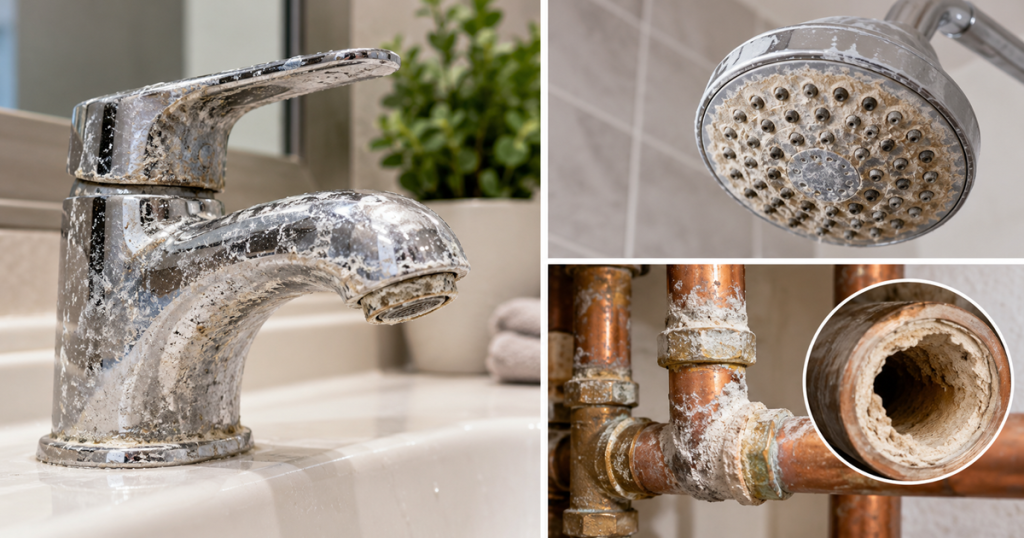
Hard water scale buildup in pipes works like plaque in an artery. Mineral layers grow year after year. That causes internal scaling and flow restriction. Your shower gets weaker, and you blame the city.
At the fixtures
You will see all of these:
- A clogged faucet aerator with grit in the screen
- Clogged showerhead nozzles that spray sideways
- White crusty buildup on fixtures around spouts and handles
- Soap scum on shower doors that comes back in days
- Spotty dishes and glassware film after a clean cycle
- Stiff laundry and detergent overuse, since soap does not lather
- Dry skin and dull hair from hard water
Fixes are simple. Soak the aerator in vinegar. Do the same for the showerhead. Cleaning a faucet flow restrictor takes ten minutes.
Hard water also causes faucet cartridge failure and dripping, premature plumbing fixture failure, and mineral buildup in toilet fill valves that makes a toilet run all night.
Metal problems
- Pinhole leaks in copper pipes show up as tiny green drips.
- Galvanic corrosion of dissimilar metals happens where copper meets steel. A dielectric union between dissimilar metals slows it down.
- Brass fitting dezincification turns brass pink and brittle.
- Solder joint failure shows as a weeping seam.
- Corrosion and tuberculation in galvanized steel pipe narrow old lines from the inside.
Color clues
- Discolored or rusty tap water after a main break
- Blue-green staining from copper corrosion in a sink
- Red and brown iron staining on a tub
- Black specks from degraded gaskets, often after a chloramine switch
Also remember backflow preventer testing. Many districts require a yearly test on irrigation systems.
Part 9: Water Heaters and Appliances
Your water heater takes the worst hit. Heat makes minerals fall out of the water fast.
Tank water heaters
- Limescale in water heater tanks forms a hard shell.
- Sediment in the water heater tank makes popping sounds.
- Scale-related element burnout is common in electric units.
- Anode rod corrosion speeds up in mineral-heavy water. The rod is meant to rust so the tank does not.
- Efficiency loss from scale means higher gas or power bills for the same shower.
- Check the temperature and pressure relief valve each year. Minerals can jam it.
- Read the fine print. Hard water can void a water heater warranty, a real exclusion from brands like A.O. Smith and Rheem.
Fix: descaling and flushing a water heater once a year.
Tankless water heaters
Tankless heat exchanger scaling is the top cause of failure. The exchanger is the expensive part. Rinnai and Navien both call for yearly service. An annual tankless flush service is cheap insurance.
Hot water extras
A recirculation pump and hot water loop give instant hot water. It also cycles mineral-rich water through your pipes all day. A thermostatic mixing valve cartridge can stick from scale.
Around the house
- Dishwasher and washing machine scale on heating elements
- Dishwasher rinse aid and spotting problems that never fully clear
- Washing machine inlet screen clogging that slows fill time
- Ice maker and refrigerator water line blockage
- Bidet and smart toilet inline filters that need swapping
- Steam shower and humidifier scaling
- Instant hot water dispenser scale
- Sprinkler head and irrigation clogging outdoors
All of this shortens appliance lifespan.
Part 10: Pipe Materials and How Long They Last
Your pipe material decides how your water treats your home.
| Material | Notes |
| Copper | Type L vs. Type M copper matters. Type L is thicker. Follows ASTM B88. |
| PEX | PEX-A vs. PEX-B differ in how they are made. Follows ASTM F876. Brands include Uponor and SharkBite. |
| CPVC | CPVC supply lines are cheap and stiff. They get brittle with age. |
| Galvanized steel | Rusts from the inside. Replace when found. |
| Polybutylene | Polybutylene pipe replacement is strongly advised. It fails without warning. |
| Cast iron | Cast iron drain line failure and cast iron sewer line deterioration are common in older homes. |
The copper pipe vs. PEX plumbing debate has a local twist. PEX bends, so it handles soil movement better. Copper is rigid and lasts a long time when water isn’t corrosive.
Know your pipe lifespan by material. Plan for replacement before the leak, not after.
Part 11: Houston Soil, Slabs, and Leaks
Water chemistry is only half the story here. The ground is the other half.
Houston’s expansive clay soil swells when wet and shrinks when dry, sometimes by several inches. That movement pushes and twists the slab. Copper supply lines and cast iron drain lines set in the slab get stressed at joints and bends until they crack. Then water escapes, soaks more soil, and the cycle repeats.
The local soil is often called Beaumont clay. Expansive clay soil is the reason slab foundation plumbing fails more here than in most of the country.
Signs of a slab leak
Watch for these:
- A warm spot on the floor in one area
- A running water sound with fixtures off
- A wet patch in yard over the pipe path
- A water bill that jumps with no change in use
A simple test helps. Turn off every faucet and appliance. Then look at your water meter. If the low-flow dial is spinning, water is escaping somewhere.
That is a basic water meter test and re-read. Know where your water meter and service line sit before you need them.
Getting it fixed
Good plumbers use acoustic leak detection and thermal imaging to detect slab leaks. They do not start breaking concrete.
Repair choices:
- Spot repair through the slab
- Pipe rerouting above slab through walls and attic
- Full repipe
Spot repairs often run about $1,500 to $4,000, rerouting about $2,500 to $5,500, and a full repipe from roughly $4,500 to $15,000 or more, based on home size. Treat those as ranges, not quotes. Whole-home repipe cost and hard water plumbing repair cost in Houston both depend on layout and access. Always get written estimates.
One warning. Foundation settlement vs. slab leak symptoms look almost the same. Fixing the foundation first, while a pipe still leaks, wastes money.
Also check for tree root intrusion in sewer lines, a separate but common problem. An under-slab supply line failure differs from a drain failure and requires a different repair.
On your bill
If a hidden leak spikes your bill, request a leak adjustment credit. Start a high-water-bill investigation with your provider. Most districts and the city have a process.
For drainage and flooding questions, the Harris County Flood Control District is the right agency, not your water provider.
Part 12: Your Water Bill, City vs MUD
City customers get one clean bill under the Houston water and sewer rate ordinance.
MUD customers get something more layered. One district explains that its monthly statement covers three separate things: the district’s own cost to run the water system, the pumpage fees charged by its regional water authority, and sewer and trash service. The district’s water charge includes operating costs, legal fees, operator fees, and its share of the master district’s costs.
So a MUD bill can include:
- A minimum monthly water bill you pay no matter what
- A tiered water rate structure that charges more as you use more
- Summer vs winter water rates in some districts
- A groundwater pumpage fee per 1,000 gallons
- A surface water pumpage fee pass-through
- A regional water authority fee line
- A surface water conversion fee on water bill
- Master district operating costs
One district published authority pumping fees of $3.40 per 1,000 gallons for groundwater and $3.85 per 1,000 gallons for surface water under an older fee schedule. Fees change often, so check the current MUD water rate order on your district’s site before budgeting.
In addition to water, MUD residents pay a MUD tax rate and water bill. One Harris County district listed a 2025 MUD tax rate of $0.3075 per $100 of property value. That is a MUD tax rate per $100 valuation, and it funds MUD bond debt service for pipes and plants already built.
City water usually costs less per gallon. MUD service often costs more, but it builds the neighborhood you live in.
Part 13: How to Fix Hard Water and Chloramine Problems
Softeners
A whole-house water softener installation is the main fix for hardness. Most units use ion-exchange resin. Resin beads trade calcium and magnesium for sodium or potassium.
Key points:
- Water softener sizing and grain capacity must match your hardness and your daily use. Too small means constant regeneration. Too big wastes salt.
- Set the regeneration cycle and hardness setting to your real tested number, not a guess.
- A water softener bypass valve and plumbing loop lets you service the unit without shutting off the house.
- Code usually requires a softener drain line air gap so waste cannot flow back.
- Watch for a brine tank salt bridge, a hard crust that hides empty salt below it.
Salt-free options
A salt-free water conditioner (TAC) uses Template Assisted Crystallization (TAC) media. It does not remove hardness. It changes the minerals so they stick less. It helps with scale. It will not stop spotting or improve soap lather. Pick it when you want low upkeep or cannot discharge brine.
Filters
- A whole-house carbon filtration system for chloramine removes taste, odor, and disinfectant.
- A catalytic carbon filter works better on chloramine than plain carbon. Both use granular activated carbon media.
- An under-sink reverse osmosis system handles drinking water only.
- A sediment pre-filter with a 5 to 20 micron rating protects everything downstream.
- For wells, an iron filter and air injection oxidation unit remove iron, manganese, and sulfur smell.
Point of entry or point of use
Point-of-entry vs. point-of-use treatment is a simple choice. Point-of-entry treatment treats the whole house and protects plumbing. Point-of-use treats one tap and protects your glass of water. Most Houston-area homes benefit from both.
Look for NSF/ANSI 44 and 53 certification. NSF 44 covers softeners. NSF 53 covers health-related filtration. The Water Quality Association also certifies products and dealers.
Helpful free information comes from the National Ground Water Association and Texas A&M AgriLife Extension.
Part 14: Codes, Permits, and Hiring Help

Do not skip this part.
Most water treatment installs require a plumbing permit. Inspectors review work under the 2015 International Residential Code, Chapter 29, with Houston amendments, along with the International Plumbing Code. Permits go through the Houston Permitting Center or your county office.
Hire a licensed plumber Houston homeowners trust. You can verify a license through the Texas State Board of Plumbing Examiners (TSBPE). A Texas State Board of Plumbing Examiners license lookup takes one minute and protects you.
For a new build, ask the builder about new construction plumbing rough-in. Ask if a softener loop and a PRV are included. Adding them later costs far more. Also ask about Houston plumbing permits and inspection records.
Part 15: Buying or Moving Into a MUD
Texas law protects buyers here. A MUD notice-to-purchaser disclosure must be given before closing. This Texas notice-to-purchaser district disclosure lists the district, its tax rate, and its debt. Read it. Do not sign past it.
Before you buy, run this moving from city water to MUD checklist:
- Find out if the district is on wells, surface water, or mid-conversion.
- Ask for the latest Consumer Confidence Report and the hardness number.
- Ask if a chlorine-to-chloramine switch is planned.
- Test static pressure at the hose bib.
- Ask the age and material of the home’s pipes.
- Ask about the MUD tax rate and current water rates.
Also do these:
- Get a real inspection. Houston home inspection plumbing red flags include polybutylene pipe, galvanized pipe, a missing expansion tank, and pressure above 80 psi.
- Check homeowners insurance coverage for pipe leaks. Many policies cover sudden damage but not slow leaks or the pipe itself.
- Read the home warranty plumbing exclusions. Hard water damage is often excluded.
Simple Action Plan
- Find your provider and get your hardness number.
- Test your pressure at a hose bib.
- Add a PRV if you are over 80 psi. Add an expansion tank if your system is closed.
- Install a softener sized to your real hardness, plus carbon filtration if you are on chloramine.
- Flush your water heater yearly. Flush a tankless unit yearly too.
- Clean aerators and showerheads every few months.
- Read your yearly water quality report.
Hard water will not hurt your health. It will quietly shorten the life of everything it touches. The good news is that every item on that list is cheap compared to a repipe.

