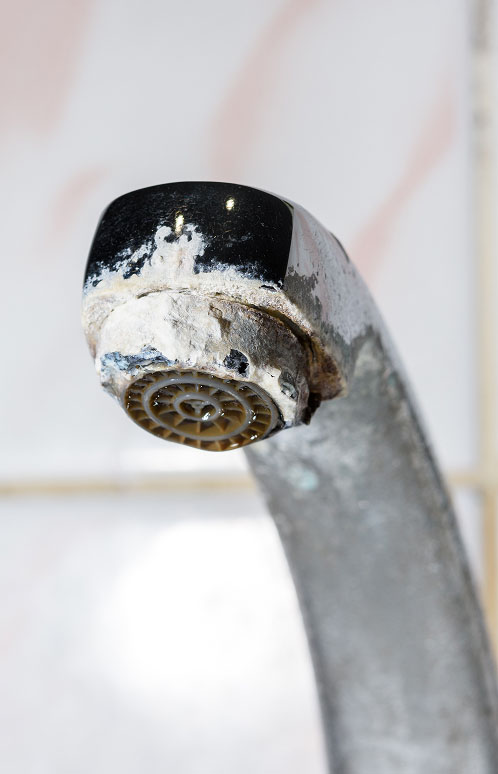
Hardness in Houston depends on which public water system serves your street. The City of Houston does not run one water supply. It runs six, and Houston Public Works tests each one separately.
Water hardness is measured in milligrams per liter (mg/L) or in grains per gallon (gpg). One grain per gallon equals about 17.1 mg/L. The Water Quality Association calls water hard above 7 gpg and very hard above 10.5 gpg. So what grains per gallon matters: it is the number that decides how big a softener you need.
Here is the total hardness from the most recent Houston water quality report published by Houston Public Works:
| Public water system | Total hardness (mg/L) | About, in grains per gallon |
|---|---|---|
| Main System (most of Houston) | 43.5 to 229, average 135.5 | 2.5 to 13.4, average 7.9 |
| Kingwood | 124 | 7.3 |
| Willow Chase | 160 to 167, average 163.5 | 9.4 to 9.8 |
| District 73 | 97.4 | 5.7 |
| District 82 | 107 | 6.3 |
| Belleau Woods | 129 | 7.5 |
Two things stand out. The Main System swung from 43.5 to 229 mg/L in a single year. That is roughly 2.5 to 13.4 grains per gallon, covering everything from soft water to very hard water within one system. The average, 135.5 mg/L or about 7.9 grains per gallon, already sits in the hard range.
That range has a cause. The Main System draws about 90.3% of its water from surface sources and 9.7% from groundwater. The surface water comes from the San Jacinto River, by way of Lake Conroe and Lake Houston, and from the Trinity River by way of Lake Livingston. The groundwater comes from 104 wells drilled more than 750 feet into the Evangeline and Chicot Aquifers. Groundwater from Gulf Coast formations is harder than lake water. When the blend at your plant shifts, your hardness shifts with it.
The system’s scale explains the rest. Houston Water serves roughly 5.5 million people across more than 650 square miles, through a network of more than 7,000 miles of pipe. The Main System alone counts about 2.97 million customers, and the utility produces close to 500 million gallons of drinking water a day. The Texas Commission on Environmental Quality rates Houston’s drinking water systems as a Superior Water Supply System, its highest rating for a Texas public water utility. Even so, a single citywide number does not describe Houston tap water well.

Houston’s Main System is disinfected with chloramine, not free chlorine. Houston Public Works reported an average chloramine level of 2.8 ppm in the Main System distribution network in 2025, with a high reading of 4.8 ppm. The Kingwood, Willow Chase, District 73, and District 82 systems reported free chlorine instead.
Chloramine is made by adding ammonia to chlorine. It is used because it keeps working longer as water travels through the pipes. That stability is good for the city and awkward for filters.
This detail determines which carbon filter you should buy. Standard activated carbon handles free chlorine well but does very little to chloramine. Removing chloramine takes a more reactive media and longer contact time, and catalytic carbon beds do this job effectively. If you are on the Main System and someone sells you a plain carbon tank for chlorine smell and chlorine taste, you may not get the result you paid for. A catalytic carbon filter is the right choice.
We check which system serves your address before recommending media. Homeowners often search for water treatment near me, get a list of national brands, and never learn this distinction exists.

Many homes in Katy, Cypress, Fulshear, and Richmond are not on City of Houston water. A Municipal Utility District serves them. Each MUD is its own public water system, regulated in Texas by the Texas Commission on Environmental Quality under the federal Safe Drinking Water Act. Each one publishes its own annual Consumer Confidence Report, and the numbers can differ a lot from the city’s.
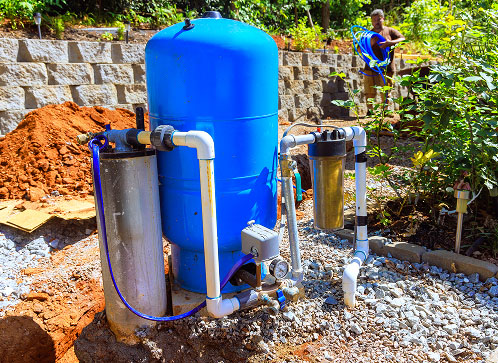
If you are on a private well, none of those reports apply to you. Well water treatment starts with a full lab test, because wells can carry iron, hardness, and bacteria that city systems treat before delivery. Well systems sometimes need an ultraviolet (UV) disinfection system that city-supplied homes do not.

Watch for these. Any two together usually mean it is worth testing.
Not every symptom needs a system. A single stained toilet tank is not a reason to spend money. Two or more of these, repeating, usually is.
Call (832) 898-4922 or request water testing, and we will measure it before anyone recommends anything.
When damage is limited to one short section, we dig to that section and replace it. A spot repair or sectional repair is the least invasive and least expensive fix. It works when the rest of the line is sound.

A water softener is the correct hard water treatment. It uses ion exchange: hard water flows through a resin tank filled with ion exchange resin that trades calcium and magnesium for sodium or potassium. When the resin fills up, a control valve rinses it with brine from the brine tank and starts over.
A water softener for city water is sized to your measured hardness and your household size, not to a package tier. Oversized units waste salt. Undersized units run out of soft water in the evening.
What a softener does not do: it will not improve taste, remove chloramine, or filter sediment. It also uses water to regenerate, roughly 25 gallons a day or up to 10,000 gallons a year, and it needs a salt refill every few weeks.
A salt-free water conditioner is a different product. It changes how minerals behave so they are less likely to stick, but it does not remove hardness. Your hardness test will read the same before and after. That can still be the right choice for some homes, and we will say so plainly.
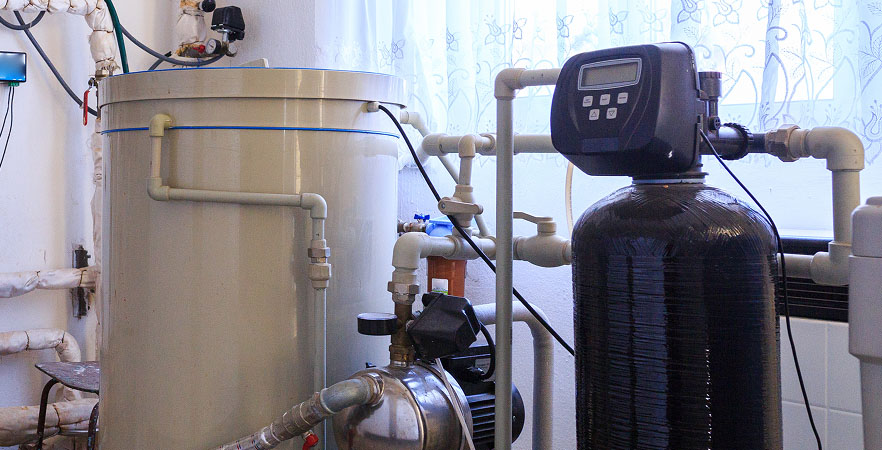
A whole-house water filtration system treats every tap in the house. Whole-house water filter installation Houston homeowners ask about usually targets taste, chlorine odor, and overall water quality.
For homes on Houston’s Main System, we specify catalytic activated carbon because of the chloramine. For homes on the smaller chlorinated systems, standard carbon is often sufficient. Whole-home filtration protects fixtures, supply lines, and appliances downstream, and it feeds cleaner water to your softener.
This type of water filtration installation ties into the main line after the meter, so it needs proper isolation valves and a bypass loop for service.

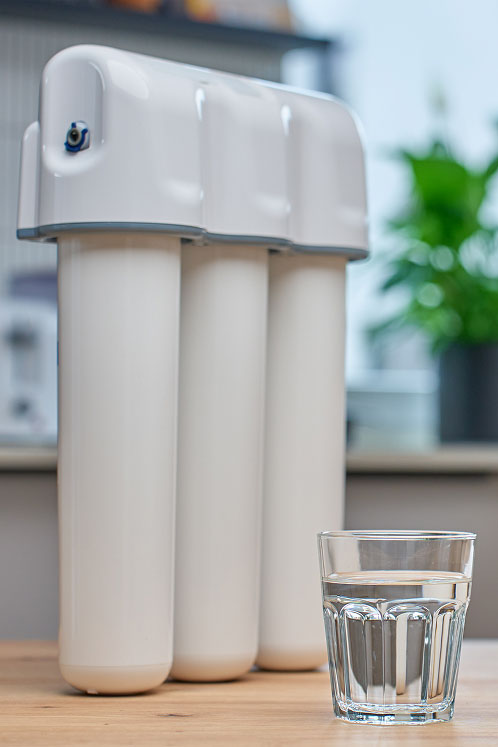
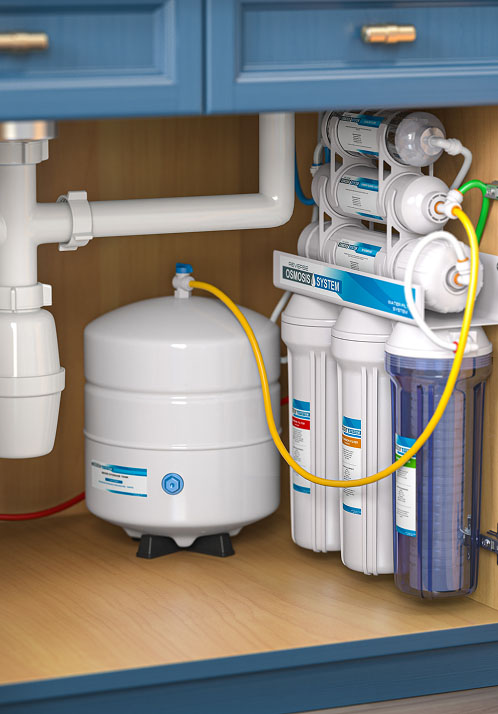
A reverse osmosis system is a point-of-use filtration system. It is the strongest drinking water system for a kitchen sink. Water is pushed through an RO membrane that blocks dissolved solids, then stored in a small under-counter tank.
Reverse osmosis under-sink installation is the standard setup: one dedicated faucet, with an optional line to the fridge or ice maker. RO reduces total dissolved solids, which Houston Public Works measured in the Main System at an average of 260 ppm in 2025, ranging from 146 to 331 ppm.
Under-sink RO filtration does not soften the whole house. It also sends some water to a drain line during operation. It is the right tool for drinking and cooking, not for protecting your plumbing.

A sediment prefilter catches grit and rust before it reaches your softener or carbon tank. In older neighborhoods and after main breaks, this small filter does a lot of work and extends the life of everything behind it.
We also install softener bypass valve hardware, dedicated shutoff valve placement, and correct air gap connections at the drain.
This is the question that costs homeowners the most money when they get it wrong.
| Your problem | Softener | Carbon filter | RO |
|---|---|---|---|
| Limescale, spotting, soap scum | Yes | No | No |
| Chlorine or chloramine taste and odor | No | Yes | Yes, at one tap |
| Sediment and rust particles | No | Partly | With prefilter |
| Lead from household plumbing | No | Only if certified | Yes, if certified |
| Dissolved solids and mineral taste | No | No | Yes |
| Protects the water heater from scale | Yes | No | No |
| Treats the whole house | Yes | Yes | No |
Many Houston homes end up with a softener plus carbon for the whole house, and an RO unit at the kitchen sink. Some need only one. Testing tells us which.

This is where a plumbing company sees things a water dealer does not.
When hard water is heated, dissolved calcium carbonate drops out of solution and hardens onto whatever is hot. Inside a tank water heater, that layer settles on the bottom and coats the water heater element. It also builds up around the dip tube. Federal research at the National Bureau of Standards found that scale and sediment from mineralized water reduce a water heater’s energy efficiency, raise service costs, and shorten its operating life.
Inside a tankless water heater, the same minerals coat the heat exchanger, which is why tankless units in hard-water areas need regular descaling.
Elsewhere in the house, scale narrows copper pipe and fittings, roughens the inside of older lines, and plugs the small screen in every faucet aerator. PEX piping resists scale better than copper, but the fixtures at the end of it still clog.
The last stretch of pipe matters more than most homeowners realize. Houston Public Works measures system water loss using American Water Works Association standards, and reported an Infrastructure Leak Index of 9.71 for 2025. Water quality is controlled at the plant, but the distribution network between the plant and your meter is long, old in places, and outside anyone’s kitchen. That is the practical argument for treating water where it enters your home.
Water treatment for older homes has one more consideration. Houston Public Works notes that lead in drinking water comes primarily from materials in the water service line and in-home plumbing, not from the treatment plant. The 2025 report showed 90% of tap samples below 5.1 ppb, with no samples above the 15 ppb action level. The city is building a service line inventory under EPA’s Lead and Copper Rule Revisions, and publishes a map where you can look up your own line material.
If your home predates modern plumbing standards, that is worth checking. The city’s own advice is direct: use a filter certified by an ANSI-accredited certifier to reduce lead, use only cold water for drinking, cooking, and baby formula, and flush the tap before use. Boiling water does not remove lead. EPA advises choosing a filter certified to NSF/ANSI Standard 53 with a stated lead-reduction claim, and also tested to NSF/ANSI Standard 42 for Class I particulate reduction. Softeners carry a different standard, NSF/ANSI 44, which covers cation exchange performance. These standards are developed with NSF International and the American National Standards Institute, and the specific model number is what gets certified, not the brand name.
You call or send a request. Tell us your symptoms and your address. A plumbing service call starts with the address because it tells us which system serves you.
We test. On-site, we run a water quality test covering hardness, chlorine or chloramine, iron, and total dissolved solids. If you want to test water hardness yourself first, a drugstore strip will give you a rough number, but it will not tell you which media you need.
We check the plumbing. We look at your main line, shutoff valve, water heater, drainage, and available space. Not every garage or utility closet fits every unit.
We explain the options. You get a plain recommendation with what each system will and will not fix, plus what it costs to maintain. Ask us for a written quote.
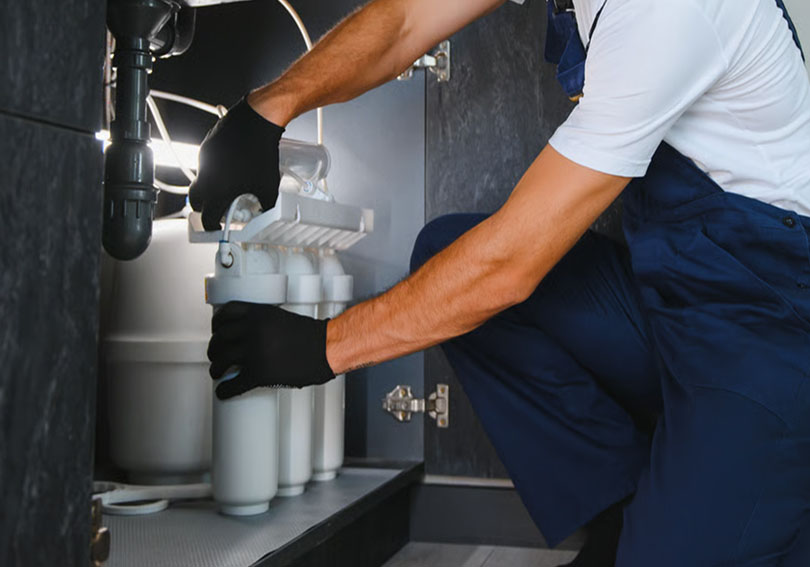
System installation. We handle the tie-ins, the bypass loop, the drain connection, and startup.
We show you how it runs. Salt levels, cartridge schedule, and what a normal cycle sounds like.

Plenty of Houston homes already have equipment that has quietly stopped working. Common signs include hardness symptoms coming back, salt in the brine tank never going down, or the unit running constantly.
Water softener repair usually comes down to the control valve, the resin, or the drain. Valves and seals are serviceable. Resin is not permanent, and a resin bed replacement can restore a good tank that is otherwise sound.
Water softener maintenance we handle includes cleaning the brine tank, checking the injector, verifying the regeneration cycle, and correcting salt bridging.
Replacement makes more sense when the tank is leaking, the unit is well past its expected life, parts are no longer made, or the repair cost approaches the cost of a properly sized new system. We will tell you which situation you are in.
Filter cartridge replacement on carbon and RO systems is routine. Skipping it is the single most common reason a system “stops working.”

A water treatment system is not an appliance you plug in. It is cut into your potable water line, and it discharges to your drain.
Texas rules require plumbing to be installed according to the plumbing code adopted by the local jurisdiction, require piping connected to the potable water supply to be installed so nonpotable substances cannot flow backward into it, and require inspection by a licensed plumbing inspector. That backflow requirement is exactly why a softener or RO drain needs a proper air gap, not a hose pushed into a standpipe.
Planet Houston Plumbing operates under Responsible Master Plumber License 46295, licensed and regulated by the Texas State Board of Plumbing Examiners. You can verify any Texas plumbing license through the board's public license search before you hire anyone, including us. A licensed plumber Houston homeowners hire should be able to give you that number without hesitating.
We are a local plumber providing residential plumbing services only. We work on homes, not commercial buildings. If you are comparing water treatment companies Houston homeowners recommend, ask each one whether the person doing the cutting and soldering is a licensed plumber or a delivery installer. It is a fair question.Our other work connects directly to this service, including water heater repair and installation, whole home repiping, and kitchen and bathroom plumbing.

Yes, in most of the city. Houston Public Works reported an average total hardness of 135.5 mg/L in the Main System in 2025 (about 7.9 grains per gallon) and 163.5 mg/L in the Willow Chase system (about 9.6 grains per gallon). Individual Main System readings ranged from soft to very hard, so your address and the season both matter.
Not automatically. Whether you need a water softener depends on your measured hardness and whether you see symptoms. If your water tests above about 7 grains per gallon and you have limescale, soap scum, or spotting, a softener is usually worth it. Below that, and with no visible scale, a carbon filter or nothing at all may serve you better.
Whether a filter removes chloramine depends entirely on the media. Standard activated carbon removes free chlorine well but does little for chloramine. Chloramine needs more reactive media and longer contact time, which catalytic carbon provides. Since Houston’s Main System uses chloramine, this choice matters here more than in most cities.
Water softener cost varies with your hardness level, household size, system type, and plumbing layout. A single under-sink RO unit and a whole-house softener plus carbon system sit at very different price points. We do not quote sight unseen. After testing, we provide a written price that includes maintenance costs, so there are no surprises later.
Whether reverse osmosis removes lead depends on certification, not technology alone. The EPA advises looking for a filter certified to NSF/ANSI Standard 53 with a specific lead-reduction claim. Many RO systems carry that certification and reduce lead effectively at that tap. Lead in Houston homes comes from the water service line and household plumbing, so point-of-use filtration is the practical fix.
How long do water softeners last depends on water quality and maintenance, and the resin wears out before the tank does. How often to change intervals vary by model and by how much sediment your line carries, so follow the manufacturer’s schedule and shorten it if pressure drops. We set a schedule for your specific system at handover.
The city answers whether Houston tap water is safe to drink every year in its Consumer Confidence Report, required under the Safe Drinking Water Act and enforced in Texas by TCEQ. The 2025 report showed disinfection byproducts under federal limits, with trihalomethanes at a highest yearly average of 43.6 ppb against an 80 ppb limit, and haloacetic acids at 40.8 ppb against 60 ppb. Most people treat water here for taste, scale, and peace of mind rather than for compliance.
Yes. If you have already purchased a softener, filter, or RO unit, we can handle the water filtration installation and connect it correctly, including the bypass, the drain, and the air gap. We will tell you honestly if the unit you bought is the wrong size or the wrong media for your water before we install it.
We provide water treatment across Houston, TX, and the surrounding communities:
Our office is at 24285 Katy Fwy, Katy, TX 77494. Business hours are Monday through Friday, 8:00 AM to 6:00 PM, and Saturday, 8:00 AM to 3:00 PM, with limited services on Sunday.

The fastest way to stop guessing is to measure. Planet Houston Plumbing evaluates your water quality and recommends a solution built around your home, your address, and your plumbing.
Call (832) 898-4922 to schedule water testing, or send a request through our contact form. You can also email info@planethoustonplumbing.com.
If we test your water and you don’t need a system, we will tell you.
Learn more about our team on our About Us page, and find answers to other plumbing questions on our FAQ page. Current offers are listed on our coupons page.